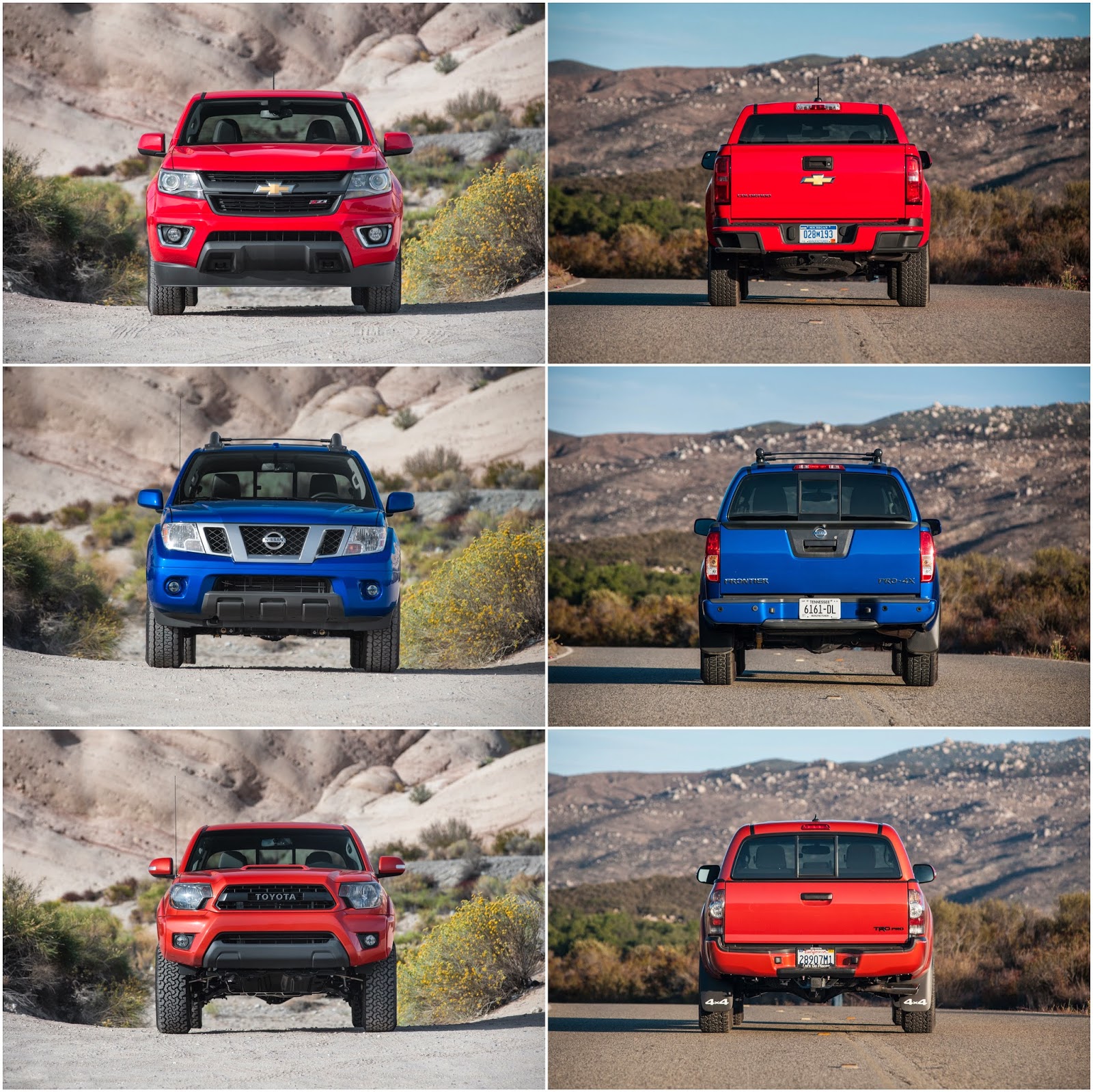
Colorado Z71 vs. Frontier Pro-4X vs. Tacoma TRD Pro

Why does anyone drive midsize pickup trucks? Per a recent Maritz market research study polling new vehicle customers, it's certainly not to go bombing down rutted trails (7 percent of respondents off-road once a month or more frequently) or for the towing ability (67 percent don't tow anything). Of those who do tow, 8 percent knowingly hook up more than 3,500 lbs (and furthering a troubling and all-too-common trend, 35 percent fess they have no clue what the weight of the objects behind them are). So we casually asked friends and acquaintances with midsize pickups: Why?
The answers condense to "I like sitting up high," "I like the size," "I grew up driving a truck," "I want to carry something big once a year," or most simply, "I like it." Basically, trucks are day-to-day transportation that just so happen to have a bed astern. With the responses filed into the back of our minds, we were ready for a three-way between 2015 Chevrolet Colorado Z71, 2015 Nissan Frontier Pro-4X, and 2015 Toyota Tacoma TRD Pro. It may look like we deliberately gathered the off-pavement oriented trims for each model, but the selection was more circumstantial than anything else.

To help with the evaluation, I enlisted the services of two individuals: testing director and supplier of 880 pounds worth of sandbags Kim Reynolds and associate online editor Jason Udy, whose extensive small truck knowhow includes once cramming a 12.3-cubic-foot speaker box into an S10 ZR2. It was probably cool then (15 years ago). Our itinerary would hit the areas of ownership deemed most relevant to the target consumer. The banzai sprint headed south of the border with teardrop trailers in tow was put on hold once again.
We began with an activity I see bro trucks (I live near Broville O.C., aka Huntington Beach, California) do every day: race from stoplight to stoplight for no apparent reason. Except instead of putting other people in harm's way and cutting off buses while blasting new rock/new country/new hip-hop music, we accelerate our trio within the confines of the test track. The Frontier's 261-hp 4.0-liter V-6 and Tacoma's 236-hp 4.0-liter V-6 feel gutsy off the line; higher speeds are more challenging when going head to head against the 305-hp Colorado. Boasting more power and an additional gear, the Chevy's 0-60 mph time of 7.4 seconds keeps a clear advantage over the Toyota (by 0.3 sec) and Nissan (0.4 sec). But the distinctive experiences quickly segregate the Japanese trucks from the American one (even if they're all manufactured in the Central Time Zone -- Colorado: Wentzville, Missouri; Frontier: Canton, Mississippi; Tacoma: San Antonio, Texas).

Udy sensed the Frontier's V-6 had the "best low-end torque but could be the most coarse-sounding engine." "Industrial" is how I labeled Nissan's grunter, both in noise and perceptible dashboard vibration. Industrial will be a keyword whenever the Frontier comes. Reynolds mustered, "This feels so much cruder than the Colorado -- and old." Crude will be keyword No. 2.
"The engine note sounds as if it has half the cylinders it actually has," Reynolds observed of the Tacoma's powertrain, whereas Udy declared: "Great low-end torque. Loud exhaust, didn't like to rev, and sounded slightly strained." TRD Pro models are fitted with a TRD cat-back exhaust you'll hear a block away.The Colorado, not crude because its development targets were set in this decade, garnered praise. Udy again: "Initially I didn't like the sound and feel of the powertrain. It felt sluggish and didn't sound like it wanted to rev. Not as much low-end torque as the competitors' larger engines. By the end of the second day, the powertrain felt livelier. Smoothest revving engine and shifted smoothly." Driving on freeways exposes the truck's main weakness, when its six-speed auto hunts for fourth and fifth gears when toeing ever so lightly into the accelerator pedal. The repetitiveness of shifting down, up, and then back down again isn't easily ignored. Yet Real MPG was exactly as expected, with the 4,511-pound Chevy benefiting from its direct-injection V-6 and aerodynamics-aiding front air dam and active grille shutters for 18/22/20 mpg city/highway/combined. The 154-pound lighter Taco sits at 18/19/18 mpg, and the 45-pound heavier Frontier at 14/19/16 mpg, both of whose basic underlying bones are now a decade old. We anticipate bro trucks of the future to run as slick as the Colorado.

Done with the track, the next test was to figure out how well the trucks rode laden and unladen. Each has tires with tall, impact-cushioning sidewalls, but let's not forget pickups traditionally don't ride as harshly with a sizeable load onboard. As Udy and I milled around the parking lot adjacent to our ride quality road, Reynolds rolled in with the Frontier, its box squatting much closer to the top of the rear tires. "It makes a huge difference in ride," he yelled out the window at us. In a good way, of course. Reynolds is referring to the 880 pounds of payload, all the weight we could procure within our narrow comparison window. For the next couple hours, we shuffle the sandbags and ride- and interior-noise-measuring test gear from truck to truck. The Nissan and Toyota ride like entirely new trucks with nearly 900 pounds in the box. The Tacoma produced 9.2 percent less average vertical g at the driver's seat compared to its unloaded state (less signifies better ride control) and didn't pitch and bounce as much with the sandbags in its smooth-texture, fiber-reinforced Sheet-Molded Composite inner bed. The Frontier clawed back 12 percent vertical g with the sand. The gap might look small, but the seat of the pants -- which is also the location where the g force is tabulated -- registered a big change.


Apparently, Chevy didn't get the ride-quality memo. Our equipment detected 2.4-percent more average vertical g with the sandbags tossed into the Colorado Z71, and it was tough distinguishing between loaded and unloaded. Perhaps the greater payload capacity (1,489 lbs to the Frontier's 1,044 and Tacoma's 1,143) helped the truck maintain more steady performance. Nevertheless, Udy asserts the Bowtie truck has the "best handling feel" with its cab-isolating ride. Consult our bar graph to see how the ride objectively shakes out.
Out on the road without sand, the Toyota felt wobbly. Commented Reynolds, "Those tires seem to make it feel very balloon-ey -- exhibits slight gyrations, which I don't like at all," before conceding, "It seems way more oriented for off-roading (the exposed suspension bits are a visual tell-tale)." It's likely the combination of the TRD Pro's BFGoodrich All-Terrain T/A KO tires and its off-road specialized suspension (longer-travel Bilstein shock absorbers, softer front springs, 1.75-inch higher front ride height over typical Tacoma) generating the on-road floatiness. But park the three trucks next to each other and you'd immediately realize which one you'd choose to tackle tough, remote terrain.

The Frontier fared a little better with Udy giving it a resounding "OK," but Reynolds was less generous. ("It rolls very quickly with turn-in, which greatly detracts from the experience.") We'd been in the trucks for barely two days and already saw the Colorado elevating the midsize bar to heights never before reached.
Reynolds on the Colorado: "Its ride is more car-like than truck-like. Its smaller-than-full size results in a dramatic improvement in nimbleness. Full-size trucks can be quite ponderous." Logically, a more compact footprint is why today's massive 1500-class truck hasn't completely taken over the pickup segment despite few mid-sized offerings. Many consumers can't justify or don't want the mass of a larger Silverado 1500, Titan, or Tundra. Reynolds remembers when Ford Rancheros and Chevy El Caminos were perfectly acceptable truck alternatives. They had the obligatory bed for the occasional utility run and you could still drive them without worrying about inadvertently encroaching on other street lanes or not being able to find parking.

Soon we were conducting our own parallel-parking trials. Low-effort electric power steering, minimal B- and C-pillar intrusion, and a lovely backup camera display on the standard (on Z71) 8-inch touchscreen made parking the Colorado painless. The Frontier's steering comes in a hopeless blend that's both slow (20.4:1 with 3.5 turns lock-to-lock) and industrial-strength heavy while parking. The Tacoma's rearward display appears on a 6.1-inch color screen, and the truck's outward visibility isn't bad. A few things threw me off, though: The taller seating height made it more difficult to gauge bumper-to-bumper distance, the hydraulically assisted power steering weighting would suddenly become heavy as the steering wheel passed true center, and the short-stroke brake pedal meant I had to be mindful of how much foot pressure I was holding. Coming off the sensitive brakes even a smidge has the truck lunging forward or backward, almost too quickly.
There wasn't much of a contest with the interior accommodations either, with everyone preferring the Chevrolet's vastly more modern cabin as a place to spend time in. After fiddling with each trucks' sound systems, Udy said: "Inside, the Colorado had the most comfortable seats. The materials and power lumbar helped. Best rear seat space and visibility. Nicest infotainment system, though no real nav. Best storage cubbies." Navigation would cost $995, including a required $500 Bose premium seven-speaker audio system.

At initial inspection, some of the Tacoma's switches and the surfaces on the dashboard, panels, and headliner look like they're shared with a mid-1990s Camry. Udy jotted down for the Toyota: "Harder to see over front headrests from back seat. Infotainment system and dash layout seemed old." The Frontier elicited a stronger reaction: "Back seat is claustrophobic. I wanted to climb out. Felt confining even with the window down, which was only the front half of the door. Materials felt cheaper, and the infotainment had a small 5.8-inch screen and graphics -- hard to read." I was most surprised the Nissan's roof rack (installed as part of the $2,100 Pro-4X Luxury Package) didn't adversely affect cabin noise since the truck turned out to be the quietest during a 65-mph cruise (23.9 sones). It's peaceful as long as the V-6 isn't trying to accelerate the truck. The Chevy and Toyota managed 24.7 (3 percent more than Frontier) and 27.1 sones (13 percent more).The Colorado infuses us with optimism that there's still life to be found in the midsize truck realm. If Chevy can assemble an exceptionally contemporary interior, replete with four USB ports (two for back-seat dwellers) and OnStar with 4G LTE Wi-Fi hot spot, who's to say Toyota and Nissan, and maybe even Ford and Ram in the future, can't do the same?"Its power is smoothly delivered (almost car-like), and its steering points into a corner quite well for a truck," Reynolds determined of the matchup-winning truck. "What's not to like? If I absolutely had to have one this would be it."For the 83 percent of Maritz survey takers who claim they'll haul something in that big box behind them at least once during the course of ownership, we believe they'll be very satisfied with the Colorado.

3rd Place: Nissan Frontier Pro-4X
Reynolds speculates Frontier buyers are more interested in the cool lifestyle activities the truck encourages (bike riding, canoeing) than the truck itself. He's probably right.
2nd Place: Toyota Tacoma TRD Pro
The Tacoma hides its age better than the Frontier, and off-road buffs know exactly what they're getting into. At least we hope they do (as they're going off-road).
1st Place: Chevrolet Colorado Z71
The previous-generation Colorado hadn't resigned on glowing terms, and Chevy didn't have to re-enter today's small-truck market. They hit this one out of the park.

Source: http://www.motortrend.com/roadtests/trucks/1412_2015_chevrolet_colorado_nissan_frontier_toyota_tacoma_comparison/