Showing posts with label chevrolet. Show all posts

Wednesday, March 25, 2015

2015 Chevrolet Colorado vs. 2015 Chevrolet Silverado: What's the Difference?


The 2015 Chevrolet Colorado and the 2015 Chevrolet Silverado have a lot of similarities. They're both newly redesigned pickups, and they're both built by Chevrolet. They're also similar in size, they offer similar interiors, and they include a lot of the same equipment. Cost is also surprisingly close; a well-equipped Colorado can easily enter the range of a Silverado. So what's the difference between the two pickups? We explain it all below.


Exterior

There's no doubt that the Chevrolet Colorado and Silverado look a lot alike, but if you study exterior details, you'll notice some major differences. Most notably, the Colorado looks a little smaller than the Silverado does, which makes sense because it is smaller. The Colorado has smaller headlights, a smaller grille, and generally less of the brawny, "tough truck" look the larger Silverado sports. The Silverado is boxier, while the Colorado has softer lines designed to help distinguish it from its big brother.


Interior

As you might expect, the interiors of the Colorado and the Silverado are similar in a lot of ways -- but just like the trucks' exterior styling, there are some distinctions. Once again, the Silverado's cabin has a more muscular flair than the Colorado's, with a column shifter, huge door handles and a wide center console being the major differences. Some Silverado models also retain a gap below the dashboard for a middle-seat passenger, while the Colorado has a full center console that runs from the area between the seats all the way to the center control stack. Size is also a key difference. While the Colorado isn't exactly hurting for interior space, it's hardly as roomy as the larger Silverado -- especially in back.


Mechanicals

The Colorado and Silverado may look similar, and some versions might be about the same size, but make no mistake, the two trucks are very different under the skin.

In the Colorado, Chevrolet will offer three engines. Base models will use a 200-horsepower 2.5-liter 4-cylinder, which is available with a manual or automatic transmission. Shoppers who want extra power can upgrade to a 300-hp 3.6-liter V6, which is only offered with an automatic transmission. And for drivers looking to save fuel, Chevrolet plans to offer class-exclusive diesel power, courtesy of a 2.8-liter turbodiesel 4-cylinder.

In the Silverado, the standard engine is a 4.3-liter V6 that makes 285 hp and 305 lb-ft of torque. While that powerplant is adequate for the full-size truck, most drivers will upgrade to a more powerful 5.3-liter V8, which makes 355 hp and 383 lb-ft of torque. At the highest end, Silverado models offer a 420-hp 6.2-liter V8. Unlike the Colorado and its standard manual transmission, all Silverados make do with a 6-speed automatic transmission.

In other words: If you want more power and increased capability from your pickup, the Silverado is definitely the way to go.


Features

Although the Silverado is technically the big brother to the Colorado, the two trucks offer about the same levels of equipment and features. There aren't many items you can't get in the Colorado that you can instead get in the Silverado until you start getting to very high-end versions like the Silverado High Country.

Of course, there are some differences in the capacities of the two trucks. For instance, while General Motors says a properly equipped Silverado can tow up to 12,000 pounds, the Colorado's tow rating is limited to around 7,000 pounds. While Chevy hasn't yet announced the Colorado's payload capacity, we can bet it stands a bit below the Silverado's 2,100-lb figure.
 

Technology

Both the 2015 Chevrolet Silverado and the 2015 Chevrolet Colorado are on the leading edge of high-tech equipment in the usually low-tech world of the pickup truck. Both trucks boast GM's new 4G LTE Wi-Fi hotspot and the automaker's OnStar telematics system. They also both offer backup cameras, a lane-departure warning system and forward collision-alert technology -- items that aren't often seen on a workhorse pickup truck.

Maybe the trucks' most advanced feature is their MyLink infotainment system. Featuring Pandora and other apps, MyLink allows drivers to stream music, get directions, and perform various other tasks. MyLink also comes with Apple's Siri Eyes Free system, which allows iPhone users to control their phones without taking their eyes off the wheel.

Most importantly, gadget lovers won't need to choose between the two trucks, since they offer about the same level of high-tech equipment -- whether standard or optional.


Safety

In government crash tests, the Silverado earned a 5-star overall score from the National Highway Traffic Safety Administration (NHTSA), thereby becoming the first full-size pickup truck to do so. We suspect that the Colorado will also earn high marks, given General Motors' strong performance in recent crash tests, but we won't know for sure until just before the truck goes on sale.

What we do know is that the Silverado and Colorado boast a long list of impressive safety features. Not only do the trucks come standard with front-side airbags, rear-side airbags and curtain-side airbags, they also boast GM's OnStar system, which offers stolen-vehicle tracking and roadside assistance. They also include a variety of safety options ranging from simple features, such as a backup camera and park assist, to high-tech equipment, such as forward-collision alert and GM's safety seat, which vibrates if you drift from your lane.

Once again, however, safety doesn't differ vastly between the two pickups; they offer about the same level of equipment. We'll find out soon whether the two trucks offer the same level of crashworthiness once the Colorado is tested by the NHTSA.

Conclusions

Although there are still a few unknowns about the 2015 Chevrolet Colorado (such as crash-test ratings and payload capacity), the differences between the Colorado and Chevrolet's larger Silverado are clear. The Silverado is for those who need a larger pickup, with bulky styling, high-grade capabilities and a larger interior. The Colorado, meanwhile, is for drivers who want something a little smaller and more compact that's easier to drive in an urban setting. Fortunately, those shoppers won't get penalized when it comes to equipment and safety features, since nearly all of the options available in the Silverado are also offered in the Colorado.


Source: www.autotrader.com/research/article/car-reviews/230395/2015-chevrolet-colorado-vs-2015-chevrolet-silverado-whats-the-difference.jsp

Tuesday, March 17, 2015

2015 Chevrolet Silverado 1500 6.2L 4x4 8-Speed Automatic


The pickup world is abuzz with talk of Ford’s new F-150 and its revolutionary (for a pickup) aluminum body. But the Chevrolet Silverado 1500 is no wallflower, having topped a recent comparison test of light-duty trucks. While most of the Chevy’s updates for 2015 are modest, the addition of GM’s new eight-speed automatic transmission to models equipped with the optional 6.2-liter V-8 makes the most of this otherwise traditional rig.

Making the Shift


Available on the high-end LTZ and High Country trim levels, the Silverado’s optional L86 6.2-liter V-8 is a beast, producing 420 horsepower and 460 lb-ft of torque and emitting a classic small-block snarl. It’s also clever, sharing much of its tech (aluminum construction, variable valve timing, cylinder deactivation, direct injection) with the Corvette Stingray’s 460-hp LT1 V-8. Paired with the previous six-speed autobox in a test of a 2014 Silverado 1500 4x4, the L86 launched the near-three-ton pickup to 60 mph in a stunning 5.4 seconds and through the quarter-mile in 14.1 at 99 mph.
The 2015 Silverado’s (and the rest of GM’s 6.2-equipped trucks’) new eight-speed Hydra-Matic 8L90 transmission has similar dimensions as the old six-speed but with a greater ratio spread, which aids both low-end grunt and high-speed cruising without incurring a weight penalty. Our 2015 Silverado High Country test truck was actually slightly lighter than the nearly identical 2014 model we drove, weighing 5658 pounds, making it one of the lightest of the species. Although the 2015 model couldn’t match the six-speed truck’s impressive acceleration—5.7 seconds to 60 mph and 14.3 at 98 mph in the quarter—shift action is quick yet smooth, overall drivability is enhanced significantly. The 6.2-liter sounds nice and burly, but no longer are tons of revs needed to get the truck up to speed, the eight-speed’s many ratios leveraging the 6.2’s abundance of torque with minimal commotion. As a result, our observed fuel economy improved from the previous High Country’s 15 mpg to 16 with the eight-speed—not bad for a vehicle this large and quick that is capable of towing up to 9200 pounds to boot.

Still Familiar


The rest of the newest Silverado changes little for 2015, which means it’s still on the sharp end of the light-duty-truck segment. It may not float over bumps like the coil-sprung Ram 1500, but it’s more nimble and carlike in feel, with relatively responsive handling and sharp, accurate steering. Overall lateral grip (0.73 g) and stopping ability from 70 mph (186 feet) are modest on the 20-inch Goodyear Eagle LS-2 rubber, but the truck is nicely composed and luxury-car quiet inside. The one demerit pinned to the eight-speed actually isn’t that consequential: top speed, which is now limited to just 99 mph versus 110 with the six-cog unit. 
 
Within the encyclopedia of modern pickup configurations, LTZ Silverados start just north of 40 grand and go up from there, with the High Country approaching $50,000 as a baseline. Opting for the 6.2 V-8 is a $2495 option, which also includes the new eight-speed gearbox, active-noise-cancellation tech in the cabin to quell engine vibrations, and a taller 3.23:1 rear axle in place of a 3.42. Our 1500-series High Country crew cab 4x4 test truck started at $52,045 before adding the bigger engine. It also tacked on a $995 power sunroof and the $950 High Country Premium package (heated steering wheel, power-adjustable pedals, integrated trailer-brake controller, lane-departure warning, forward-collision alert, and GM’s vibrating Safety Alert seat) for a grand total of $56,485. That’s a lot of money for a light-duty pickup that still swills a gallon of fuel every 16 miles. But it’s also immensely capable and comfortable and surprisingly quick. If you don’t want to spend the extra cash for a diesel heavy-duty truck but still need more power than the Silverado 1500’s 355-hp 5.3-liter V-8—or just want the speediest Silverado available—GM’s new extrastrength powertrain makes for a highly rewarding option.
News Source: http://www.caranddriver.com/reviews/2015-chevrolet-silverado-1500-4x4-62l-v-8-8-speed-test-reviews

Saturday, March 14, 2015

2015 Ford F-150 vs. 2015 Chevrolet Silverado 1500, 2015 Ram 1500, 2014 Toyota Tundra


Let's go places built tough like a rock and grab life by the horns.


As any dime-store undergrad psych major can tell you, it’s a tough climb to the top of the hierarchy of needs pyramid, the point at which we supposedly have everything we desire. There are challenges at every level, from finding solid traction in the physiological realm to cresting the summit of self-actualization. Any base full-size pickup truck has the capability to get you there, but if you’ve got around $60,000 to spend, why settle for anything less than total fulfillment in a crew-cab, four-wheel-drive, luxury salon on stilts?

So the dean of the needs hierarchy himself, Abraham Maslow, is in the metaphorical driver’s seat for this comparison of top-of-the-line, half-ton personality haulers. Of course, Chevrolet and Ford are here, as are Ram and Toyota.


Naturally, the paradigm-shattering event that inspired this test is the all-new 2015 Ford F-150. Now fitted with a cab and bed that use aluminum instead of steel for every panel except the fire wall, the F-150 is potentially the great breakthrough the truck world has been secretly craving. But there’s still some cognitive dissonance here as this now mostly aluminum truck was maxed out for our test with the highest “Platinum” trim. Will a turbocharged V-6 be enough to overcome such an internal contradiction?

In general specifications, the Chevrolet Silverado is stunted. It’s mostly steel, there are leaf springs supporting it in back, and the engine is a straightforward pushrod V-8 that shares its bore spacing with the small-block that Chevy introduced 60 years ago. But there’s a primitive satisfaction that comes with familiar engineering; it’s a comfort zone where minds can relax. And, according to the trim, that zone is sold as the High Country. 


Cushioning the world’s vicissitudes with a set of air springs, the Ram 1500 is practically a mood stabilizer. Under its hood is a Hemi V-8 featuring the only iron engine block in the test. Further, it is upsetting that this cowboy-chic Ram Laramie Longhorn can’t figure out if it’s a large sheep, a town in Wyoming, or a cow.

Toyota’s Tundra appears here in elongated “CrewMax” form, which sounds suspiciously like a hormone-therapy drug. The V-8 under its hood is equipped with four cams and 32 valves, or as many valves as Chevy and Ram use combined. Like the F-150, this Tundra is a “Platinum” model, though the only use of that metal in the truck is likely a few precious grams in the catalytic converters. That may be authentic enough for marketing purposes, but it’s hardly a coherent personality strategy. Relax on the chaise as we examine further. 


2014 Toyota Tundra Platinum 4x4 CrewMax

Fourth place: Full-Size Pickup Trucks.

The Tundra is indeed a rolling existential crisis. Toyota’s profits don’t depend upon it, and it seems developmentally challenged anyway. Just more than 100,000 were sold last year, and it’s not clear how many people—save those who assemble it in Texas—would miss the Tundra if it were to go away. It’s been 16 years since Toyota sold its first Tundra, and these teenage years are proving awkward.

The Tundra was refreshed for the 2014 model year, and most of its substance is familiar from the 2007 redesign, including the chassis and the 381-hp 5.7-liter DOHC 32-valve port-injected V-8 under the hood. Eight years ago the engine was class-leading. Today it sounds ragged and loud. And while the Tundra’s V-8 is more powerful than the F-150’s EcoBoost V-6, it trails behind all contenders in torque production. 


Light, unsettled, and fitfully communicative steering has the $49,820 Tundra always feeling as if it’s driving on tippy-toes, though the P275/55R-20 Bridgestone Dueler tires are the same size as those on two of the other trucks. The rear axle is always dancing beneath its leaf springs instead of settling down for a freeway cruise. There’s an anxiety built into the chassis that cries for a Freudian reengineering.

Designed to emphasize its mass, the Tundra’s styling didn’t earn much affection. Too self-conscious, verging on the insecure. Inside, the plastics look cheap, and the diamond-tufted leather upholstery accents seem archaic. The seats themselves are accommodating, the instrumentation is easily scanned, and visibility is excellent. But the navigation and infotainment system is outmoded. Break out the smartphone.

This is the only pickup in which the entire rear window rolls down electrically, and that’s a boon to anyone running the Tundra with a shell or camper. And since this is an extended CrewMax model, rear legroom is epic. 


Roaring through the six gears of its automatic transmission, the 5894-pound Toyota made it to 60 mph in 6.7 seconds and through the quarter-mile in 15.3 seconds at 92 mph. That’s ahead of the even heavier Ram, but well behind the lighter Ford and Chevy. The Tundra’s combination of prodigious weight and short highway gearing resulted in a worst-in-test 14-mpg observed fuel economy.

The Tundra is a capable hauler and Toyota trucks have a hard-won reputation for long-lasting durability, but that’s not enough to earn it any love, much less esteem. 


2015 Ram 1500 Laramie Longhorn Limited 4x4 Crew Cab

Third place: Full-Size Pickup Trucks.


Leaving its former identity as a Dodge behind, the $57,810 Ram 1500 has a significant advantage over the other players here. Its air-sprung suspension produces the most controlled and comfortable ride. In fact, it rides so well that it calls into question why the others are sticking with rear leaf springs for the relatively light duties that half-ton pickups encounter.

What that suspension has to contend with, however, is 5964 pounds of Ram. While that’s only 70 pounds greater than the ­Toyota, it’s almost 400 more than the Ford. That mass smothers ­performance. The 5.7-liter Hemi pushrod V-8 is rated at 395 horsepower and feeds its torque to an eight-speed automatic transmission, but it takes 7.4 seconds for the Ram to hit 60 mph and 15.7 seconds for the quarter-mile to pass at 88 mph. That weight also shows up in braking distances, with the Ram taking 10 more feet, for a total of 199, than the next-worst pickup in the stop from 70 mph. 


In normal traffic, the Ram doesn’t feel slow or strained, but the steering is numb and takes a bit more effort than the other trucks’. It’s a small price to pay for the composed ride. And there’s something amusing about a truck that lowers its own ride height during cruising for aerodynamic efficiency, then boastfully announces its achievement on a screen between the tach and speedometer. It’s a smug one, this Ram.

Though the Hemi lacks leading-edge tech such as direct injection, it has a cylinder-deactivation system that shuts down half the combustion chambers under light loads. That helps the Ram carry the same EPA mileage ratings as the lighter Silverado, or 15 mpg city and 21 highway. On our test, we ran in, up, and around California’s Panamint Valley, chasing wild burros and getting buzzed by low-flying F-16s while achieving an average of 15 mpg, 1 mpg better than the Tundra.


A rotary dial at the bottom of the center stack selects the transmission gears and may seem wimpy compared with the big sticks in the other trucks, but it pays off. It frees up the center console for oversized cup holders and a massive storage bin under the armrest. The rest of the interior is straightforward, intuitive, comfortable, and full of interesting surfaces. The front captain’s chairs are regal, there’s plenty of room in the back, and the material quality is a big leap forward for Chrysler products.

There’s no identity crisis with the Ram. Its appearance is a direct development of the little big-rig styling introduced for the 1994 model year. Adding the optional, usable RamBox bins in the rear fenders makes it better but shrinks the floor down to 51 inches wide for the length of the bed. That’s between 13.6 and 15.4 inches narrower than the others.

Still, the Ram is lovable. And that’s always something. 


2015 Chevrolet Silverado 1500 High Country 6.2L 4WD Crew Cab

Second place: Full-Size Pickup Trucks.

Chevy’s full-sizer is consistently familiar. Though it was all-new last year, it doesn’t look that much different from the previous three generations of big Chevy pickups. There’s nothing particularly novel in its chassis design, either, and the body is made mostly of plain old steel. It’s a truck’s truck: unpretentious, self-confident, and full of classic virtues such as a column-mounted shifter. And at 5658 pounds, it’s only 81 pounds heavier than the aluminum F-150.

More than two inches shorter in height than the other trucks, the Silverado seems to hunker down on the road. From inside, it feels comparatively smaller, tidier, and easier to place between parking-lot lines. The Chevy’s ride is stiffer than the Ram’s and the Ford’s, but its steering is more responsive with better feedback. There’s a direct, engaging feel to how the Silverado drives that’s missing from the other trucks. 


At 420 horsepower, the direct-injection, variable-valve-timing, 6.2-liter EcoTec3 small-block V-8 is the most powerful in the test, and it’s complemented by GM’s new 8L90 eight-speed automatic transmission. It’s a version of the same transmission now offered in the Corvette, and it keeps the engine in the thick part of its power band without resorting to manual shifting. The wide ratio spread, along with GM’s cylinder-deactivation system, allowed this large V-8 to average 16 mpg, matching the Ford’s turbo V-6.

Considering the Silverado’s power and weight, we expected it to be the test’s rocket. But at 5.7 seconds to 60, it was actually a tenth behind the Ford. Even so, by the end of the quarter-mile the Chevy’s additional horsepower showed up to beat the Ford by a tenth, running the distance in 14.3 seconds at 98 mph. Clearly, Ford and Chevy pickups remain as closely matched as they ever were.

The column shifter frees up center-console space, and the Silverado’s infotainment system was the easiest to master using the eight-inch touch screen built into the center stack. The dash design is straightforward, with most controls oversized and conventional dial gauges where so many vehicles have gone digital. 


Soft upholstery in a caramel hue with contrasting piping and stitching makes the interior feel like the world’s most comfortable five-seat catcher’s mitt. Buster Posey’s signature should be embroidered on the headrests. Our scoring has the Silverado finishing behind the F-150. The Chevy is good enough that something as simple as a styling preference or the need for your business to use magnetized signs on the truck’s doors could sway a purchase without regrets. This is a truck that’s easy to embrace. It knows what it wants to be. 


2015 Ford F-150 Platinum 3.5L EcoBoost 4WD SuperCrew

First place: Full-Size Pickup Trucks.

The new F-150 seems engineered to make us forget that it’s made of aluminum. Everything is oversized, from the shiny plastic door handles thick enough to fill your palm to the heavy doors that need to be muscled open like a 737’s. Inside, the seats are fulsomely tufted, the dashboard appears massive and blocky, and there’s a huge shifter in the center console that could have been salvaged off the bridge of the HMS Ark Royal. Ford has saved some weight by going nonferrous, but it’s not about to cede the F-150’s reputation as a tough hauler.

And it hasn’t saved that much weight. At 5577 pounds, this $61,520 F-150 still weighs more than two Fiesta STs. It’s the lightest truck in this test, but not by as much as it should be. There’s truth to the quip that by saving 600 pounds, Ford finally got its truck to weigh as little as a Chevy. 


That noted, this F-150 is as quiet as an aluminum tomb. Good insulation and excellent management of the air around the vehicle keep down noise. The sounds that are heard—some tire rumble, a hint of turbo whine—are muffled or pleasant.

With an eight-inch digital screen embedded between the speedometer and tach, the F-150 offers the most advanced and easiest to read instrumentation. Throw in the new 360-degree camera system that eases everything from hitching up a trailer to crawling over obstacles at low speed and the Technology package here is the most fully ­realized and the best available. The Sync entertainment system still isn’t as intuitive or as smart as we’d like, but it’s getting better.

With rear leaf springs, the F-150 can’t match the Ram for ride quality, and it isn’t as athletic as the Silverado, but its ride-and-handling balance may be the best. Though some found the steering too light, others thought it nicely weighted, even if it doesn’t have much to say. 


The twin-turbocharged 3.5-liter EcoBoost V-6 bears a rating of 365 horsepower. It’s well matched to the six-speed automatic transmission, but extracting the performance one expects in today’s trucks means keeping the turbos on boil almost all the time. That burns fuel, and the F-150 only matched the Silverado’s 16 mpg during our mixed on- and off-road exploration of the Panamint.

The perfect truck—the self-actualizing full-size hauler—would be as nimble as the Silverado, ride like the Ram, and pack in the useful technology of the F-150. Right now Ford is the best compromise, even if perfect fulfillment still eludes it.

Ah hell, Abraham Maslow probably never drove a truck anyhow.


Final Scoring, Performance Data, and Complete Specs  


News Source: http://www.caranddriver.com/

Wednesday, March 4, 2015

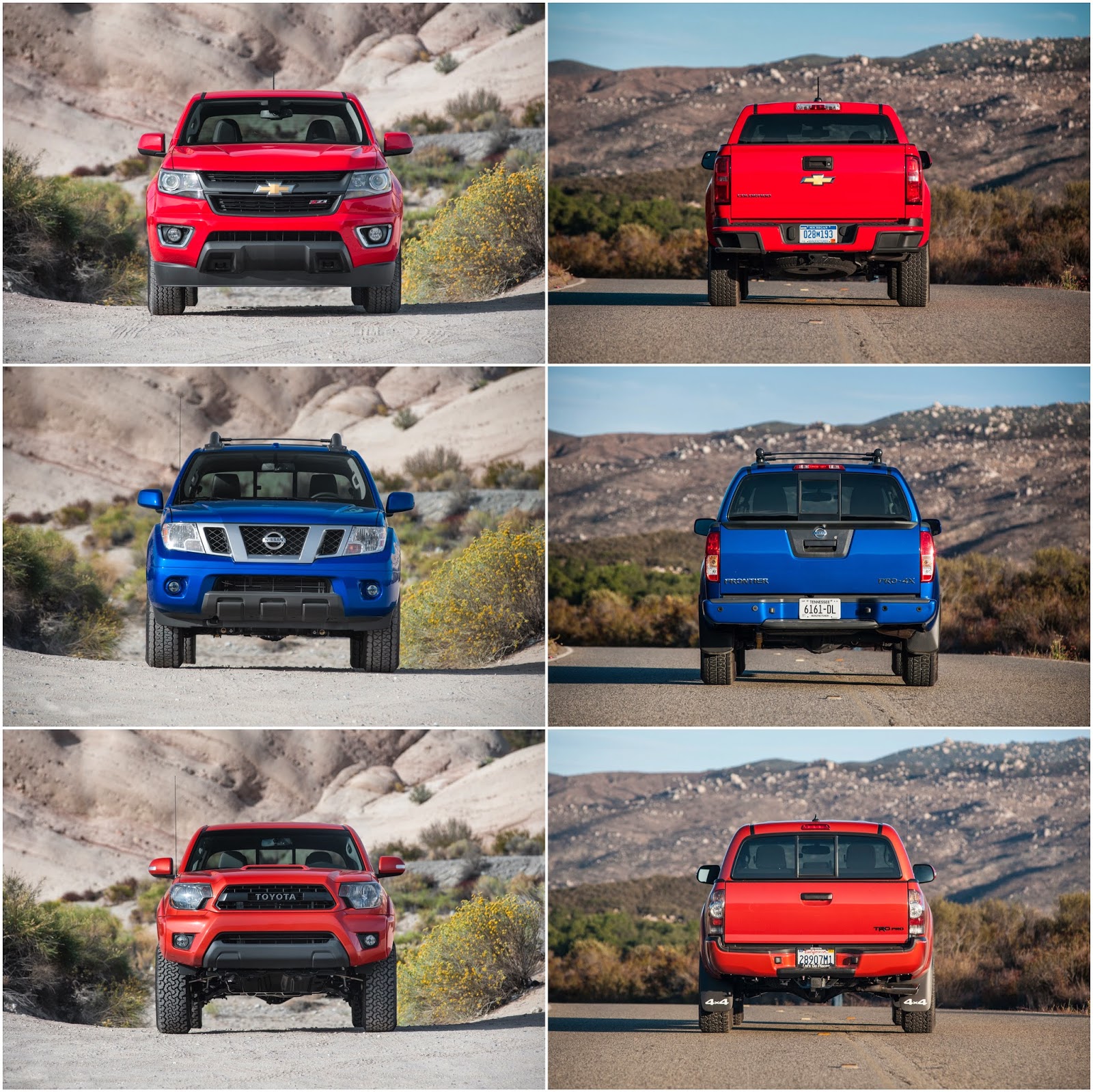
Comparison: Chevrolet Colorado vs. Nissan Frontier vs. Toyota Tacoma


Colorado Z71 vs. Frontier Pro-4X vs. Tacoma TRD Pro


Why does anyone drive midsize pickup trucks? Per a recent Maritz market research study polling new vehicle customers, it's certainly not to go bombing down rutted trails (7 percent of respondents off-road once a month or more frequently) or for the towing ability (67 percent don't tow anything). Of those who do tow, 8 percent knowingly hook up more than 3,500 lbs (and furthering a troubling and all-too-common trend, 35 percent fess they have no clue what the weight of the objects behind them are). So we casually asked friends and acquaintances with midsize pickups: Why?


The answers condense to "I like sitting up high," "I like the size," "I grew up driving a truck," "I want to carry something big once a year," or most simply, "I like it." Basically, trucks are day-to-day transportation that just so happen to have a bed astern. With the responses filed into the back of our minds, we were ready for a three-way between 2015 Chevrolet Colorado Z71, 2015 Nissan Frontier Pro-4X, and 2015 Toyota Tacoma TRD Pro. It may look like we deliberately gathered the off-pavement oriented trims for each model, but the selection was more circumstantial than anything else.


To help with the evaluation, I enlisted the services of two individuals: testing director and supplier of 880 pounds worth of sandbags Kim Reynolds and associate online editor Jason Udy, whose extensive small truck knowhow includes once cramming a 12.3-cubic-foot speaker box into an S10 ZR2. It was probably cool then (15 years ago). Our itinerary would hit the areas of ownership deemed most relevant to the target consumer. The banzai sprint headed south of the border with teardrop trailers in tow was put on hold once again.

We began with an activity I see bro trucks (I live near Broville O.C., aka Huntington Beach, California) do every day: race from stoplight to stoplight for no apparent reason. Except instead of putting other people in harm's way and cutting off buses while blasting new rock/new country/new hip-hop music, we accelerate our trio within the confines of the test track. The Frontier's 261-hp 4.0-liter V-6 and Tacoma's 236-hp 4.0-liter V-6 feel gutsy off the line; higher speeds are more challenging when going head to head against the 305-hp Colorado. Boasting more power and an additional gear, the Chevy's 0-60 mph time of 7.4 seconds keeps a clear advantage over the Toyota (by 0.3 sec) and Nissan (0.4 sec). But the distinctive experiences quickly segregate the Japanese trucks from the American one (even if they're all manufactured in the Central Time Zone -- Colorado: Wentzville, Missouri; Frontier: Canton, Mississippi; Tacoma: San Antonio, Texas).


Udy sensed the Frontier's V-6 had the "best low-end torque but could be the most coarse-sounding engine." "Industrial" is how I labeled Nissan's grunter, both in noise and perceptible dashboard vibration. Industrial will be a keyword whenever the Frontier comes. Reynolds mustered, "This feels so much cruder than the Colorado -- and old." Crude will be keyword No. 2.

"The engine note sounds as if it has half the cylinders it actually has," Reynolds observed of the Tacoma's powertrain, whereas Udy declared: "Great low-end torque. Loud exhaust, didn't like to rev, and sounded slightly strained." TRD Pro models are fitted with a TRD cat-back exhaust you'll hear a block away.The Colorado, not crude because its development targets were set in this decade, garnered praise. Udy again: "Initially I didn't like the sound and feel of the powertrain. It felt sluggish and didn't sound like it wanted to rev. Not as much low-end torque as the competitors' larger engines. By the end of the second day, the powertrain felt livelier. Smoothest revving engine and shifted smoothly." Driving on freeways exposes the truck's main weakness, when its six-speed auto hunts for fourth and fifth gears when toeing ever so lightly into the accelerator pedal. The repetitiveness of shifting down, up, and then back down again isn't easily ignored. Yet Real MPG was exactly as expected, with the 4,511-pound Chevy benefiting from its direct-injection V-6 and aerodynamics-aiding front air dam and active grille shutters for 18/22/20 mpg city/highway/combined. The 154-pound lighter Taco sits at 18/19/18 mpg, and the 45-pound heavier Frontier at 14/19/16 mpg, both of whose basic underlying bones are now a decade old. We anticipate bro trucks of the future to run as slick as the Colorado.


Done with the track, the next test was to figure out how well the trucks rode laden and unladen. Each has tires with tall, impact-cushioning sidewalls, but let's not forget pickups traditionally don't ride as harshly with a sizeable load onboard. As Udy and I milled around the parking lot adjacent to our ride quality road, Reynolds rolled in with the Frontier, its box squatting much closer to the top of the rear tires. "It makes a huge difference in ride," he yelled out the window at us. In a good way, of course. Reynolds is referring to the 880 pounds of payload, all the weight we could procure within our narrow comparison window. For the next couple hours, we shuffle the sandbags and ride- and interior-noise-measuring test gear from truck to truck. The Nissan and Toyota ride like entirely new trucks with nearly 900 pounds in the box. The Tacoma produced 9.2 percent less average vertical g at the driver's seat compared to its unloaded state (less signifies better ride control) and didn't pitch and bounce as much with the sandbags in its smooth-texture, fiber-reinforced Sheet-Molded Composite inner bed. The Frontier clawed back 12 percent vertical g with the sand. The gap might look small, but the seat of the pants -- which is also the location where the g force is tabulated -- registered a big change.


Apparently, Chevy didn't get the ride-quality memo. Our equipment detected 2.4-percent more average vertical g with the sandbags tossed into the Colorado Z71, and it was tough distinguishing between loaded and unloaded. Perhaps the greater payload capacity (1,489 lbs to the Frontier's 1,044 and Tacoma's 1,143) helped the truck maintain more steady performance. Nevertheless, Udy asserts the Bowtie truck has the "best handling feel" with its cab-isolating ride. Consult our bar graph to see how the ride objectively shakes out.

Out on the road without sand, the Toyota felt wobbly. Commented Reynolds, "Those tires seem to make it feel very balloon-ey -- exhibits slight gyrations, which I don't like at all," before conceding, "It seems way more oriented for off-roading (the exposed suspension bits are a visual tell-tale)." It's likely the combination of the TRD Pro's BFGoodrich All-Terrain T/A KO tires and its off-road specialized suspension (longer-travel Bilstein shock absorbers, softer front springs, 1.75-inch higher front ride height over typical Tacoma) generating the on-road floatiness. But park the three trucks next to each other and you'd immediately realize which one you'd choose to tackle tough, remote terrain.


The Frontier fared a little better with Udy giving it a resounding "OK," but Reynolds was less generous. ("It rolls very quickly with turn-in, which greatly detracts from the experience.") We'd been in the trucks for barely two days and already saw the Colorado elevating the midsize bar to heights never before reached.

Reynolds on the Colorado: "Its ride is more car-like than truck-like. Its smaller-than-full size results in a dramatic improvement in nimbleness. Full-size trucks can be quite ponderous." Logically, a more compact footprint is why today's massive 1500-class truck hasn't completely taken over the pickup segment despite few mid-sized offerings. Many consumers can't justify or don't want the mass of a larger Silverado 1500, Titan, or Tundra. Reynolds remembers when Ford Rancheros and Chevy El Caminos were perfectly acceptable truck alternatives. They had the obligatory bed for the occasional utility run and you could still drive them without worrying about inadvertently encroaching on other street lanes or not being able to find parking.


Soon we were conducting our own parallel-parking trials. Low-effort electric power steering, minimal B- and C-pillar intrusion, and a lovely backup camera display on the standard (on Z71) 8-inch touchscreen made parking the Colorado painless. The Frontier's steering comes in a hopeless blend that's both slow (20.4:1 with 3.5 turns lock-to-lock) and industrial-strength heavy while parking. The Tacoma's rearward display appears on a 6.1-inch color screen, and the truck's outward visibility isn't bad. A few things threw me off, though: The taller seating height made it more difficult to gauge bumper-to-bumper distance, the hydraulically assisted power steering weighting would suddenly become heavy as the steering wheel passed true center, and the short-stroke brake pedal meant I had to be mindful of how much foot pressure I was holding. Coming off the sensitive brakes even a smidge has the truck lunging forward or backward, almost too quickly.

There wasn't much of a contest with the interior accommodations either, with everyone preferring the Chevrolet's vastly more modern cabin as a place to spend time in. After fiddling with each trucks' sound systems, Udy said: "Inside, the Colorado had the most comfortable seats. The materials and power lumbar helped. Best rear seat space and visibility. Nicest infotainment system, though no real nav. Best storage cubbies." Navigation would cost $995, including a required $500 Bose premium seven-speaker audio system.


At initial inspection, some of the Tacoma's switches and the surfaces on the dashboard, panels, and headliner look like they're shared with a mid-1990s Camry. Udy jotted down for the Toyota: "Harder to see over front headrests from back seat. Infotainment system and dash layout seemed old." The Frontier elicited a stronger reaction: "Back seat is claustrophobic. I wanted to climb out. Felt confining even with the window down, which was only the front half of the door. Materials felt cheaper, and the infotainment had a small 5.8-inch screen and graphics -- hard to read." I was most surprised the Nissan's roof rack (installed as part of the $2,100 Pro-4X Luxury Package) didn't adversely affect cabin noise since the truck turned out to be the quietest during a 65-mph cruise (23.9 sones). It's peaceful as long as the V-6 isn't trying to accelerate the truck. The Chevy and Toyota managed 24.7 (3 percent more than Frontier) and 27.1 sones (13 percent more).The Colorado infuses us with optimism that there's still life to be found in the midsize truck realm. If Chevy can assemble an exceptionally contemporary interior, replete with four USB ports (two for back-seat dwellers) and OnStar with 4G LTE Wi-Fi hot spot, who's to say Toyota and Nissan, and maybe even Ford and Ram in the future, can't do the same?"Its power is smoothly delivered (almost car-like), and its steering points into a corner quite well for a truck," Reynolds determined of the matchup-winning truck. "What's not to like? If I absolutely had to have one this would be it."For the 83 percent of Maritz survey takers who claim they'll haul something in that big box behind them at least once during the course of ownership, we believe they'll be very satisfied with the Colorado.


3rd Place: Nissan Frontier Pro-4X


Reynolds speculates Frontier buyers are more interested in the cool lifestyle activities the truck encourages (bike riding, canoeing) than the truck itself. He's probably right.

2nd Place: Toyota Tacoma TRD Pro


The Tacoma hides its age better than the Frontier, and off-road buffs know exactly what they're getting into. At least we hope they do (as they're going off-road).

1st Place: Chevrolet Colorado Z71


The previous-generation Colorado hadn't resigned on glowing terms, and Chevy didn't have to re-enter today's small-truck market. They hit this one out of the park.


Source: http://www.motortrend.com/roadtests/trucks/1412_2015_chevrolet_colorado_nissan_frontier_toyota_tacoma_comparison/

Friday, February 27, 2015

What Is the Best SUV for the Money?


There's no simple answer to the question "What is the best SUV?" The reason is that the question isn't specific--the best for what, exactly? Even "What is the best suv for the money" is too general. This article will cover answers to different takes on the basic question of the best SUV.


What Is the Best SUV to Buy for High Resale Value?


With gas prices in a constant state of flux, what is the best SUV to buy to ensure high resale value is a common concern. The Land Rover Range Rover is one option. Although Land Rover has been wholly-owned by the Indian conglomerate Tata since 2008, this has done little to negatively impact the resale value of Land Rover vehicles, especially the top-line Range Rover. Thanks to strong lease programs offered by Land Rover Capital and Chase Bank, high residual values have been maintained for clients who purchase and lease. To get an idea of the high resale value of the Range Rover, check out the classified ads available on CarsDirect. 


Not only can you request quotes on new Range Rovers, you can also search used cars available for sale by dealerships and private parties alike. This guide will help you understand why it is important to purchase an SUV with high resale value. Although the Range Rover holds its value very well, reading this article can also help you choose a less expensive SUV that offers high resale value.

Why High Resale Value Is Important


Whether you choose to lease a new car, finance a new car or finance a used car, resale value is an important way to calculate the overall value represented by a transaction. In the long run, a high resale value can save money whether you purchase or lease. For example, on a lease, the projected resale or residual value is a key component in calculating a monthly payment. Monthly lease payments are based on the difference between the selling price of the vehicle (the capitalized cost) and the value of the vehicle at the end of the lease (the residual value). You pay only this difference, divided by the length of you lease, plus any applicable finance charges and other lease fees.

For example, if a Range Rover sells for $79,275 and has a 60% residual value on a 36 month lease, you are paying the difference between the selling price of $79,275 and the residual value of $47,565, or a total of $31,710 to lease the vehicle (plus finance charges). If you plan to switch vehicles regularly, a high residual can get you a low lease payment and allow you to drive a new vehicle more frequently. If you finance vehicles, resale value is less important, but it can still be a major factor if you plan to trade your vehicle in. If your vehicle has poor resale value, there may be too much negative equity to secure financing.

High resale value is something that few buyers consider when shopping for an SUV. However, by choosing a luxury SUV like a Range Rover, you can feel comfortable knowing that it will be easier to trade-in your vehicle and have a lower monthly payment. The residual values used to calculate leases change on a monthly basis, so be sure to contact a local dealership for this information. However, it is important to make sure high resale value is not your sole reason for choosing a particular SUV, as the SUVs with the best resale values may not fit every buyer's needs or budget.

What Is the Best SUV to Buy for Fast Acceleration?


If you are looking for a utility vehicle with some of the best acceleration you can find, you may want an idea of what is the best SUV to buy. SUV's are typically known for having high traction levels and being able to get you through the rougher, off-road terrain at levels that any sedan or compact car would never be able to. However, fast acceleration and overall speed is becoming a larger interest among SUV enthusiasts. With this in mind, here are some of the fastest SUV's available today to keep in mind while considering the best overall choice: 


Jeep Grand Cherokee SRT8
This SUV comes with a V8 Hemi that puts out around 420 horsepower. The SRT8 Grand Cherokee will go from 0-60 mph in 4.8 seconds and run the 1/4 mile in 13.5 seconds from a standing start. These times are fast enough to stack up against cars such as the Jaguar XF or Audi S8; making it a true high performance sport-SUV. 

 
Porsche Cayenne

The Porsche Cayenne can go 0-60 mph in roughly 5 seconds flat and do the 1/4 mile in 13.6 seconds from a standstill. This vehicle has power output that is upwards of 550 horsepower depending on which engine and trim you decide to choose. Regardless, the Porsche Cayenne lives up to it's name and is a very fast SUV. 

 
BMW X6 xDrive50i
The BMW X6 is a new, sport-tuned version of the BMW X5. When purchased in this trim level, the X6 comes with a twin-turbo 5.0-Liter V8 engine that puts out around 400 horsepower. The X6 has car-like handling and goes 0-60 mph in roughly 5.3 seconds, making it very agile from a dead stop. 


Mercedes Benz ML63 AMG
The Mercedes Benz ML63 AMG is a finely tuned sport utility vehicle with luxurious features and great performance. The ML 63 AMG comes with a 6.2-Liter V8 engine that produces 510 horsepower and 465 lb-ft. of torque that made it the most powerful naturally aspirated (non-turbocharged) SUV in the world. From a standstill, it can go from 0-60 mph in roughly 4.7 seconds with a 1/4 mile of 13 seconds flat @ 108 mph as well. 


Mercedes Benz G55 AMG
This SUV put down a 0-60 mph time of just 4.7 seconds and did the 1/4 mile in roughly 13.2 seconds to put it on the list. This car comes with a 5.4-Liter supercharged V8 that puts out about 493 horsepower and 516 lb-ft. of torque as well. 


Infiniti FX50
The Infiniti FX50 is a larger version of Infiniti's FX35/40 SUV with a 390 horsepower engine that propels the vehicle from 0-60 mph in 5.2 seconds and allows it to run the 1/4 mile in 13.7 seconds @ 102 mph from a standstill. This allows the vehicle to compete with the Mitsubishi Lancer Evolution X in regards to acceleration.


When it comes to acceleration, these SUV's all rank among the best. The Mercedes Benz ML63 AMG is the overall fastest accelerating vehicle on the list in regards to 0-60 mph and 1/4 mile times. However, these six SUV's are all within about a second of one another, making them the fastest SUV's available.

What Is the Best SUV to Buy for Low Insurance?

People often wonder about the best SUV to buy for low insurance. This is because there are a lot of SUV models in the market that are very safe; hence they require a low insurance. The answer to the question, "What is the best SUV to buy for low insurance?" is the 2010 Toyota Land Cruiser. 


The 2010 Toyota Land Cruiser is considered to be the best SUV to buy for low insurance. The SUV is held in such high regard because its safety features are much better than any other SUV in its class. The 2010 Toyota Land Cruiser is designed to offer optimum safety to its passengers and drivers. Here is what makes it so safe and thereby the best SUV to buy for low insurance.

Anti-Lock Brakes
The 2010 Toyota Land Cruiser is equipped with a set of 4-wheel anti-lock brakes. These brakes are designed to prevent the wheel from being locked up by the brake pressure's automatic modulation. This comes in handy in a case when the 2010 Toyota Land Cruiser has to be stopped in the case of an emergency. Its main function is to make sure the wheels do not get locked. It also helps the driver in maintaining full control over the steering. Another function it serves is it helps in stopping the SUV at the shortest possible distance in an emergency.

Electronic Stability Control
The 2010 Toyota Land Cruiser is also equipped with an Electronic Stability Control (ESC). It is a computerized technology designed to help with the improvement of stability in the latest Land Cruiser. It does so by simply detecting and minimizing the skids. The moment the ESC notices a loss of steering control, the system itself applies the brakes in a way the vehicle is steered the way it is intended by the driver. It is very important in case of emergency stops or while driving on the slippery roads. 


Airbags
The presence of airbags is one of the factors that contribute to the security of the people driving and traveling in the SUV. The 2010 Toyota Land Cruiser has a number of air bags meant for every person sitting in it. In the front side, the SUV has two impact air bags, one for the driver and one for the passenger. The airbags meant for the driver and the passenger is mounted on the seat. There also is a knee air bag for the driver and the passenger sitting in the front seat. The 2010 Toyota Land Cruiser also comes with a rear side-impact airbag designed to cushion all sorts of blows coming from the rear side of the SUV. For additional safety, there also is an overhead impact airbag that has been designed to offer proper cushioning to the people sitting in the 1st, 2nd and 3rd row, from all sorts of impacts. These airbags ensure the optimum safety of the passengers.

What Is the Best SUV to Buy for Driver Comfort?

When you are shopping for the best SUV to buy there are a variety of considerations that must be accounted for. For many drivers who spend hours in their SUV on a daily basis, having a vehicle that is very comfortable is a paramount concern. Depending on your budget, there are a variety of SUVs to consider that provide good foot space and comfortable seats. As you may have a set budget in mind, this guide discusses the best SUVs in three price ranges: entry-level SUVs, upscale SUVs and luxury SUVs. When you are prepared to request pricing information on an SUV, be certain to use a service like CarsDirect to get competitive quotes on vehicles for sale in your area. CarsDirect will put you in touch with dealerships that can offer quick quotes on new and used vehicles.


Best Entry-Level SUV for Driver Comfort: Chevrolet Tahoe


The Chevrolet Tahoe offers an entry-level body-on-frame SUV for drivers who require three rows of seating. For additional driver comfort, there is an available power adjustable driver's seat with power lumbar support. All Tahoes have dual-zone climate control and a tilt steering wheel with a quick release. Even though the Tahoe can seat up to eight passengers comfortably, the driver has plenty of room and good foot space in front. Most Tahoes include a center console that provides separation from the front passenger and includes plenty of room to keep commonly-used CDs and accessories at hand. A new Tahoe starts in the mid $30,000 range depending on equipment, but there are many great examples of used Tahoes on the market. 


Best Upscale SUV for Driver Comfort: Saab 9-7x


While the Saab 9-7x is directly related to the less comfortable Chevrolet Trailblazer and GMC Envoy, the Saab 9-7x takes General Motors's basic five-passenger SUV platform and brings it upscale through the use of soft-touch materials throughout the cabin, a lower ride height for easier driver step-in and the use of a more premium leather than in its more basic relatives. The Saab 9-7x offers a standard power driver's seat with lumbar adjustment and green-faced gauges that are comfortable to read in all conditions. While the rear seat of the 9-7x is very small, the driver has ample legroom and an easily-adjustable tilt steering wheel. Automatic dual-zone climate control is also within easy reach from the driver's seat, ensuring that it is always the right temperature in the cabin. The Saab 9-7x was discontinued after the 2009 model year, but there are some great used examples available on CarsDirect. 


Best Luxury SUV for Driver Comfort: Mercedes-Benz GL-Class


Introduced for the 2007 model year, the Mercedes-Benz GL-Class offers an array of driver comfort options, like heated seats, power steering wheel adjustments and voice-controlled navigation. Whether you elect the GL350 BlueTEC diesel, GL450 or GL550, you will get an impressive array of standard features including a standard full-time all-wheel drive system. A GL may also be equipped with power folding rear seats and a backup camera to keep the driver as comfortable as possible. When you are looking for a new SUV in the $60,000 to $80,000 range, it is hard to beat the overall value offered by the GL. If you are shopping used, a certified pre-owned GL-Class carries a warranty until 100,000 total vehicle miles.

What Is the Best SUV to Buy for a Good Warranty?


When you are shopping for the best SUV to buy, the factory warranty coverage provided by the manufacturer is an important consideration to focus on. Whether you drive your vehicle infrequently or tens of thousands of miles per year, good factory warranty coverage can provide peace of mind throughout your term of ownership. Most manufacturers offer good warranty coverage so that they may be competitive with other brands and so they can prove that their vehicles are the most reliable on the road.

Case in point: many manufacturers instituted long powertrain warranties because it forced them to build better vehicles. Simply put, having bad powertrains covered by 100,000 mile warranties could quickly bankrupt a manufacturer. If you are purchasing an SUV new, just be sure to review the warranty information listed on each manufacturer's website before making a buying decision. If you are preparing to purchase a used SUV, ask the dealership about extended warranty coverage that might be available. You may also be able to make a bulk purchase of warranty coverage from a third-party warranty company. Just make sure that the coverage is equivalent to that offered by the factory warranty.

The Best SUV for a Good Warranty 


The best sport utility vehicle to purchase for a good warranty is the Hyundai Santa Fe. The Santa Fe is an excellent mid-sized SUV that has improved significantly since it was first introduced for the 2000 model year. In its current form, the Santa Fe offers three rows of comfortable seating and an array of interior amenities, including available leather seating surfaces and touch-screen navigation. Even more impressive than the options available on the Santa Fe and its attractive starting price in the low $20,000 range is the comprehensive and largely-transferable warranty offered by Hyundai.

The Hyundai Warranty

The central component of Hyundai's warranty coverage is the 10 year or 100,000 mile powertrain warranty that covers most engine and transmission/transaxle components that are defective from the factory. This portion of the warranty is not transferable for vehicles from the 2004 model year onward. Older vehicles from the 1999 to 2003 model years have a 10 year/100,000 mile powertrain warranty that is transferable to immediate family members. 


Even if you purchase your Hyundai Santa Fe used, you will still get a comprehensive five year or 60,000 mile warranty on most factory-installed components that are found to be faulty. However, there are a few exceptions to the transferable bumper-to-bumper warranty, including a three year or 36,000 mile restriction on radio and audio system replacement, a three year or 36,000 mile limit on paint coverage, a three year and unlimited mileage restriction on the battery and a one year or 12,000 mile adjustment warranty that also includes coverage for wear items like brake pads, clutches and wiper blades.
Some final key components of Hyundai's SUV warranty include a seven-year anti-perforation warranty that protects against rust-through and five-years/unlimited miles of roadside assistance from Hyundai. All told, the good warranty provided by Hyundai to the first and subsequent owners of a Santa Fe mean you can purchase with confidence and drive knowing that your vehicle is backed by the best warranty in the industry.

What Is the Best SUV to Buy for Passenger Space?


People often look for the best SUV to buy judging on certain specific criteria. Most people judge a certain SUV according to the passenger space it offers. There are a lot of SUV options that offer similar passenger space. Hence, there always is a debate as to what is the best SUV to buy for passenger space. Well, here is a look at the absolute best SUV according to the passenger space it offers.

The 2010 Chevrolet Suburban 1500

When it comes to offering the passenger space, the 2010 Chevrolet Suburban 1500 is right at the top. It offers a spacious seating capacity to accommodate a total of 9 people leaving enough space for cargo. In fact, even with a total of 9 people the inside of the SUV does not feel cramped. The seats are designed in a way to offer full space to the nine people sitting inside the 2010 Chevrolet Suburban 1500 without a discomfort of any sort.

The Front Space
The Front Space of the 2010 Chevrolet Suburban 1500 is designed for the driver and a fellow passenger. The 2010 Suburban 1500's front area has a leg room of 41.3 inches. The headroom offered by the front space is 41.1 inches. The hip room of 64.4 inches offered by the 2010 Chevrolet Suburban 1500 is also really good and so is the shoulder room of 65.3 inches.

The Rear Space
The 2010 Chevrolet Suburban 1500 has an extremely good rear space. The space offers a rear legroom which is more than enough at a total of 39.5 inches. Also, the rear headroom is good enough at 38.5 inches. When it comes to the shoulder room the rear space of the 2010 Chevrolet Suburban 1500 does not disappoint at all. The shoulder room is a total of 65.2 inches. 


The Third Row

The 2010 Chevrolet Suburban 1500 has an additional third row with a removable 50-50 split-bench. The bench offers a comfortable and spacious seating. The t hird row has a really spacious leg room at a total of 34.9 inches. The headroom offered in the third row of the 2010 Chevrolet Suburban 1500 is also really good at a total of 38.1 inches. The third row is also designed to offer a hip room of 49.4 inches. Also, the shoulder room offered in the third row of the 2010 Chevrolet Suburban 1500 is pretty good at 64.7 inches. The passengers sitting in the third row do not feel cramped at all. In fact, the third row is pretty comfortable at all.

Passenger Comfort
The 2010 Chevrolet Suburban 1500 is designed to offer the utmost passenger comfort. The front, rear and the third row have been designed to offer complete space for the passengers to stretch their legs and arms as well as the rest of the body in an easy way. The unique design offers a spacious seating without causing any felling of being cramped, even with the maximum of nine people sitting inside at a time. The space and the passenger comfort offered by the 2010 Chevrolet Suburban 1500 is the best among all the SUVs in the market today.

What Is the Best SUV to Buy for Durability?


The best SUV to buy depends on its specifications and its durability. Throughout the years, the popularity of SUVs has increased and as a result people are now putting more and more thought into their purchases. Generally, SUVs are very comparable to station wagons. The only difference is that SUVs are structured on a light-truck chassis. Some SUVs can be used for off-road trips, while others have a pickup style capacity.
SUVs are particularly recognized for having a higher ground clearance compared to other automobiles. With multiple SUV manufacturers, it's hard to determine which one is really durable and of high quality. The following models are the latest offerings on the market today. Each SUV type has been acknowledged for their durable structure, well-built and advanced components. 


2010 Ford Escape Hybrid
The 2010 Escape Hybrid has a typical 4-door and 5-passenger seating capacity. The SUV is available in 4 trims and is considered as a limited type model from the company. Since the release of Ford's FWD, experts and other enthusiasts have acknowledged its 2.5-liter, I4 hybrid engine. The hybrid engine introduced has a 153-horsepower and can reach around 34-mpg when driven within the city. The car can achieve 31-mpg when driven on the highway. The Ford Escape Hybrid is known for its well built body structure. Because of its acclaimed engine system and well structured body type, experts note that this car will last long. 


2010 Cadillac SRX
The 2010 Cadillac SRX has a 4-door and 5-passenger seating capacity. The SRX is available in 9 trims. The 2010 SRX is part of Cadillac's AWD Turbo Premium Collection. It has a durable engine system that is also well regarded by many in both the industry and the market. The car has a 3.0-liter, V6 engine capable of producing 265-horsepower. When driven within the city, the car can reach up to 18-mpg. It can reach 25-mpg when out on the highway. Previous collections from the AWD Turbo Premium group were built with equipped 2.8-liter, V6, 300-horsepower engine. The 2010 Cadillac SRX is a restructured version of the previous SRX model. It has more engine power and durability. 


2010 GMC Terrain
The 2010 GMC Terrain also has a 5 passenger seating capacity and 4-door body type. The car is available in 8 trims. This SUV model is available in editions such as the SLE1 FWD and the SLT2 AWD. GMC released a version of the GMC Terrain through the SLE1 FWD. This SUV type features a 2.4-liter, I4 engine that can produce 182-horsepower. The SUV can reach 22-mpg and 32-mpg within the city and the highway, respectively. The transmission system, structure and GMC's emphasis on its ability to manufacture cars that can withstand time contributes to the durability and dependability of the car.

These are just some of the newest offerings to consider when looking for the best SUV to buy.

What Is the Best SUV for a New Driver? 


An SUV first-time buyer will often ask "what is the best SUV to buy?" Such a question is very difficult to answer in precise terms due to the differences in perception and perspective regarding the term "best." Instead of telling what make or model is the best buy, the new driver should use these criteria when looking for an SUV.

Manual or Automatic Transmission?

The trend for new SUV models these days is automatic transmission. If you are going on a trip across the country with the whole family, you will be glad that you can just sit back and take your mind off an additional pedal while cruising along the highway. Similarly, a new driver will welcome the fact that he gets to immediately drive instead of laboriously trying to learn the theory of the stick shift.

An SUV that has the option of automatic and manual transmissions is the best buy though. Once a new driver gets enough practice, he will want to gain extra control over the vehicle and "tame" the beast for himself. The last thing a new driver wants is to be treated as a newbie for the rest of his life. Unless you are only buying the SUV as a training vehicle, arrange for the new driver to gradually become comfortable with both manual and automatic transmission systems. This way he is enabled to make his own choices instead of you choosing for him all the time.

Used or Brand New?

The general expectation for new drivers is that, since they do not have the necessary breadth of experience, they will make mistakes. These mistakes can be really nasty. Almost all drivers will remember their first fender benders and it is a rare driver indeed that will get parallel parking right the first time.

Buying a used SUV for your new driver is definitely the cost-effective solution because unlike brand-new SUV's you can just leave a bumped fender as is without feeling overly conscious about it. However, this mindset might lead to the formation of bad habits and clumsy behavior.

Because the SUV is used, the new driver can easily be tempted to drive around recklessly, knowing that any accidents he may have won't matter much. It is therefore recommended that a new or slightly new SUV be purchased. This should give the new driver some food for thought and teach him to value safety over adventure.

Combustion, Electric or Hybrid?

It's never too early to teach a new driver to care for the environment. Part of that lesson is choosing which engine goes with the SUV. The type of SUV you buy for your new driver gives a hint of how you treat the environment.

Many old drivers think that electric or hybrid SUV's perform a lot more poorly than their combustion counterparts, even if research proves them false. This is generally because they have been using combustion engines all their life and using something else makes them feel uncomfortable. Buying your new driver an electric or hybrid SUV will allow him to make a better judgment regarding performance later on in his driving career. Who knows? Maybe your choice will usher in a new wave of environmentally conscious drivers.

What Is the Best SUV to Buy for Good Handling? 


When looking for the best SUV to buy in terms of good handling, many are looking at the Infiniti EX35. The Infiniti EX35 is a sport-luxury crossover SUV. The EX35 is markedly smaller than other similar vehicles from rival companies, but the EX35 more than makes up for its smaller size with superior handling, high-class interior design, and high-tech gadgetry.

Handling and Performance
The greatest strength of the EX35 lies in its superior handling. The SUV's front mid-ship platform's handling dynamics are set to perfectly center the car's weight. This provides excellent steering response and keeps the EX35 perfectly balanced throughout the tightest curves and bends in the road. The EX35's excellent handling rivals that of smaller, lighter vehicles and makes this SUV drive like a sports sedan. This certainly sets the EX35 apart from its bulkier competitors.

The EX35's VRQ6 engine produces 297 horse power and 253 lb. feet of torque. Normally, an engine with this much power would perform at its best at higher RPMs, but the SUV's designers paired the engine with five-speed automatic gearing to allow the EX35 to run smoothly at any speed. The SUV can operate in either of two modes: automatic or "manumatic". The EX35 incorporates the use of an advanced learning algorithm when in automatic driving mode. The algorithm works to adapt the SUV's shifting to your own driving style to maximize the engine's performance. Alternatively, the manumatic mode can be used to shift gears manually. When in manumatic mode, fore and aft taps to the shifter will shift the SUV to higher and lower gears, respectively.

The Infiniti EX35 comes in rear-wheel-drive-only and all-wheel-drive versions. The all-wheel-drive system of the latter version constantly adjusts the vehicle to changing road surface conditions. The all-wheel-drive system could be an invaluable feature for drivers who frequently have to deal with less-than-ideal road conditions. The EX35's fuel economy is 17 MPG on city roads and 24 MPG on highways. Driving in both conditions yields approximately 21 MPG.

Interior Design
The EX35's interior was designed specifically with driver and passenger comfort and ergonomics in mind. While the SUV comes with a number of "gadgets" in addition to more standard controls, all controls are laid out to be perfectly within reach of the driver. Additionally, all controls "remember" their settings, so setting up the controls settings for different drivers or driving conditions is made that much easier. Possibly the only design flaw for the EX35's interior lies in the lack of leg room for the rear seats; this is compensated somewhat by the backs of the front seats being concave to provide rear-seat passengers with a little more room.

High-Tech Features

The Infiniti EX35 comes with an optional technology package. This package, which comes at an additional $2,250, features a number of additions to promote safe driving, including a lane departure warning, distance control assist, and intelligent cruise control and brake assist. Even without this optional package, the EX35 comes with an Around View Monitor system, Bluetooth functionality, a navigation system and an iPod control port, among other features.

While the best SUV to buy for good handling will be a matter of personal preference, the Infiniti EX35 will certainly match that description for many drivers.

Related Questions and Answers


Besides Land Rover, What Other SUVs Have a High Resale Value? 


The Toyota Sequoia is one model that has a high resale value simply because of the quality of the car. The car has roomy interiors and is easy to maintain. Kelley Blue Book typically assigns two or three year-old models really great resale prices. The Ford Expedition is also a good value for the money. Other SUV models with high resale values can be found on the Kelley Blue Book, including the Suzuki Grand Vitara SUV and the Subaru Forester, 2.5X AW.

What SUVs Have Low Resale Value?


Before you buy an SUV, it is a good idea to check with Kelley Blue Book - where resale values of SUV models are listed one or two years into ownership. On the whole, almost all cars depreciate in value with increased use but these few models seem to lose more than half their value in the first two to three years of ownership. For example, the Kia is a well known brand that creates wonderful cars with smart interiors - but this SUV model depreciates more than 64% of its value, making it a poor resale model. Another equally poor investment is the Suzuki Grand Vitara. This model has a cheaper sticker price but costs double to maintain in the long run due to higher insurance costs and doubtful fuel economy.

What is the Average Resale Value for Most SUVs?

The average resale value of an SUV will depend on the sticker price of the car, dealer price, servicing costs and maintenance done in the years before resale, insurance costs and the distance covered by the car during that same period of time. On average, SUVs depreciate anywhere from 52% in three years to more than 40% in five years on the sticker price. The best way to get the best and current valuation is by using Kelley Blue Book which has reliable car information and can provide accurate three and five year resale valuations on your car model.

What is the Fastest SUV Available? 


Owning an SUV can be a fun thing to do, especially since they are so much bigger than regular cars, and some people own the fastest SUV on the market today. For the most part, a consensus has been formed amongst vehicle testers, that the 2007 Mercedes Benz ML63 AMG is the fastest SUV available for purchase. This vehicle was clocked at 4.5 seconds when going 0-60 MPH. If the vehicle were to drive a 1/4 mile, it could reach its destination in 13.0 seconds at a rate of 108.1 MPH. This vehicle meets the Cadillac XLR-V and the Pontiac G8 GXP in a dead heat.

Can I Buy an SUV Warranty at a Different Place Besides the Dealership?


Yes, you can buy an SUV warranty in other places than your dealership. Numerous websites offer aftermarket dealer warranties that may be cheaper than those offered by the dealer. Independent warranty companies offer a wide variety of options for you to consider. It is imperative that you review these alternative options just like you would a warranty offered by your dealer. Not all online companies are reliable, so carefully research your options beforehand. Every auto warranty company should fax, email or provide you a copy of the warranty ahead of time for you to review. If they don't, you shouldn't sign the warranty.

What is the Most Popular Car Warranty Scam?


The most popular car warranty scam is what is often referred to as a "third-party warranty". Third party warranties are those offered by companies that have no direct business interest in covering your car. In fact, these warranties differ from a manufacturers extended warranty by offering compensation or coverage for repairs the warranty company never intends to cover. The biggest problem is that these warranty companies tell you to bring your car to a dealership or repair shop for repairs, claiming they will reimburse you for the damages. The problem comes when you attempt to collect the money and the warranty company refuses to pay or even return phone calls.

Is a Mechanical Breakdown Warranty a Waste of Money When Buying a New Car?


When buying a new car, it is generally considered a waste of money to purchase a mechanical breakdown warranty. These warranties typically cover mechanical failures in vehicles, and are best suited for high mileage cars that may experience maintenance issues on account of age, or wear and tear. Not only is a new vehicle potentially covered by a drivetrain warranty, it also has a manufacturer's extended warranty on it. Furthermore, most of the failures a mechanical breakdown warranty covers are directly a result of high mileage and wear and tear. Meaning, that your new vehicle shouldn't be suffering from these problems in the first place. If it does, it is likely a mechanical defect and covered under your other warranties.

Do All New SUVs Come with a Factory Car Warranty?

All new vehicles, including SUVs, come with a factory car warranty. In fact, your new SUV should come with multiple warranties bundled together. These include: a powertrain warranty, a bumper to bumper warranty, and warranties that cover the restraint system, roadside assistance, anti-corrosion and even adjustments and maintenance. Some of these warranties (such as roadside assistance), are purchased at an additional cost, depending on the manufacturer. However, nearly every new vehicle will include a bumper to bumper warranty for a specific amount of years and mileage, as well as a powertrain warranty.

Does a Lifetime Car Warranty Really Exist?


Chrysler is the only manufacturer to have offered a lifetime car warranty. This warranty covered the powertrain of your vehicle for your lifetime. However, most believe the deal isn't worth purchasing, since few people keep cars for that many years. In recent years, Chrysler has backed off of the lifetime warranty to some extent, though they still offer it. Most auto manufacturers offer extended warranties. Some even as long as ten years and 100,000 miles. This proves to be a far better value. Lastly, it is important to note that Chrysler's lifetime warranty only covers the powertrain (and likely only manufacturer defects).

What is the Highest Selling SUV Under $25,000? 


There are a number of options for buying an SUV for under $25,000. The winner of the most popular SUV under $25,000 category is going to depend on whether you want a brand new vehicle or if a certified pre-owned vehicle is acceptable. In the pre-owned category, the 2006 Jeep Grand Cherokee, with an average price (depending on options) of around $22,000 is the winner hands down. Jeep has been a leader in the SUV market for a number of decades and continues this dominance into today. For new SUVs you have your choice of the Kia Sorrento, Subaru Outback and the four-door Chevy Equinox LS. 


Are 6 Cylinder Engines Standard for Most SUV Models?


If you're looking for a 6 cylinder SUV, in order to balance fuel economy and power, you're in luck. Most of the mid-size SUVs are available with 6 cylinder engines. The Jeep Cherokee, for instance, comes standard with a 3.6 liter V-6 engine that delivers 280 HP and mileage up to 23 on the highway. The Chevy Equinox also comes with a V-6 engine, displacing 3.0 liters and producing 264 HP. The Jeep Wrangler, one of the most overall popular SUV body styles ever, comes standard with a 3.8 liter V6 engine that produces 202 HP and delivers 19 miles per gallon.

Which SUV has the Worst Rollover Rating?


Because of small SUVs like the Suzuki Samurai and Geo Tracker, many people have become very interested in SUV rollover ratings. These are ratings assigned by various testing agencies, both independent and affiliated with either the government or the insurance industry on various aspects of vehicle crash worthiness and safety. The NHTSA Rollover Rating is based upon vehicle weight and center of gravity. According to this rating, the Chevy Blazer and GMC Jimmy have the highest likelihood of rolling over during a single car crash, of the available SUVs on the market. The NHTSA rating system is based on a five star rating, with five being the best. These two vehicles rated one star. 


Are There Any 9 Passenger SUV Models Out There?

You've got a large family and are looking for a 9 passenger SUV. You're in luck, as there are currently four 9-passenger SUV options on the market. The Venerable Chevy Suburban 1500 tops this list, with an average price tag of $39,000. Next comes the Chevy Tahoe, with an average retail price of $36,000. The next two 9-passenger options are from Ford. The first is the Excursion, Ford's gigantic SUV introduced in the '90s. Priced between $37,000 and $50,000, the Excursion is going to dig pretty deeply into your wallet to get the options and extras you want. Ford's always popular Expedition is the last 9-passenger SUV available to you. With prices between $37,000 and $43,000, this SUV is also going to dig into your wallet to get it equipped the way you want it.

Are There Any SUVs with a Three Row Seat Capacity?


Nine-passenger SUVs are also three row SUVs. What this means is that any SUV that can seat nine people will have three rows of seats. This includes the Chevy Suburban and Tahoe. Ford adds the Excursion and Expedition to the mix. The Expedition's third row seat is electrically powered to raise and lower for use, meaning if you don't need to carry nine people, you will have added cargo capacity. The Lincoln Navigator, from Ford, seats eight and comes with a powered third row seat. The Nissan Armada, while seating only eight, also has an optional folding third row seat, which gives it seating for eight.

 News Source: http://www.carsdirect.com